As an evidence-informed organization, we use two metrics to measure our success and evidence our impact: the increased legal capability of the justice workers we train, and the impact of the justice workers’ support on clients’ poverty-related outcomes.
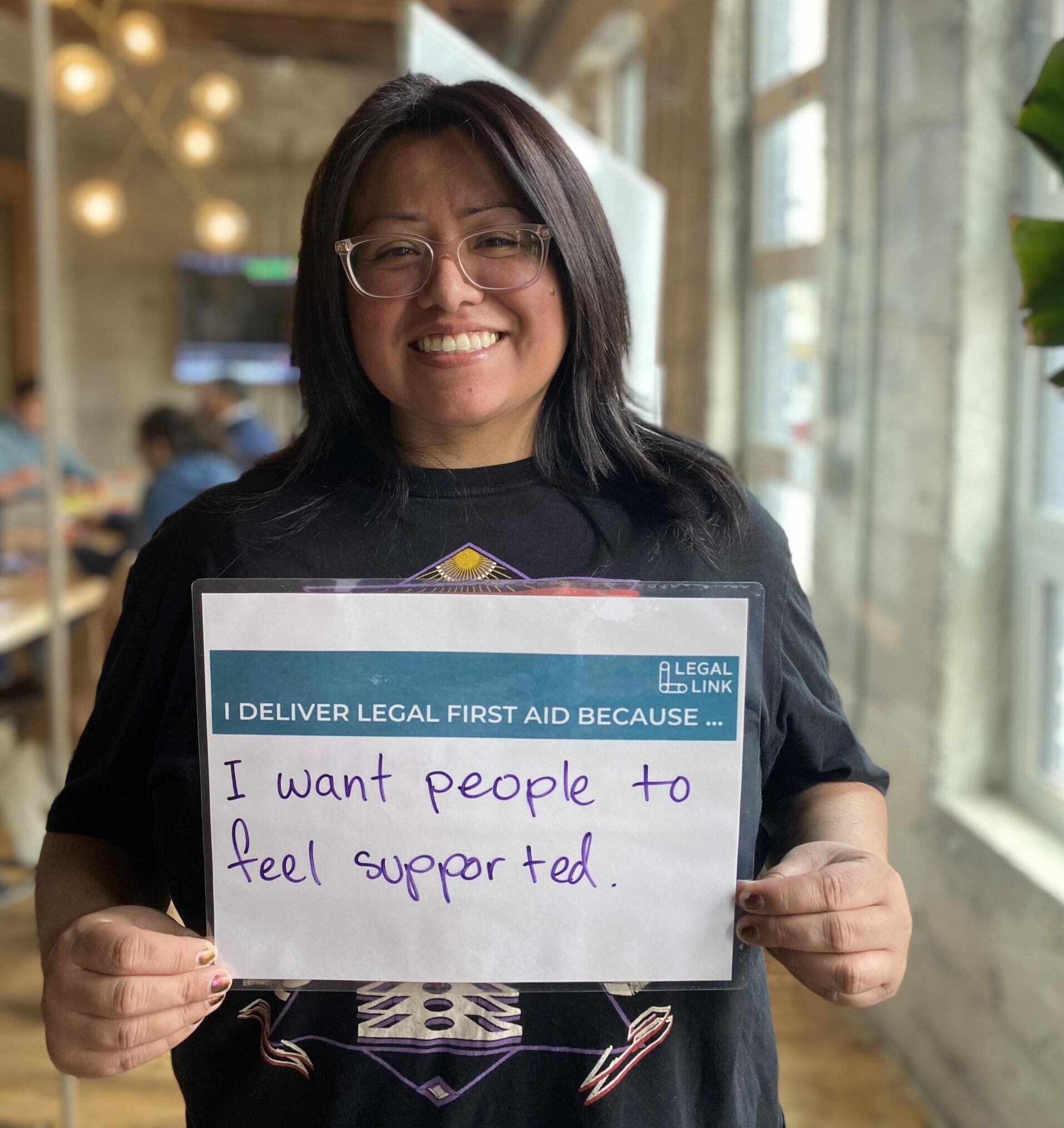
More than 4,000 partners across six states have completed Legal First Aid® training, gaining the tools to spot legal issues, take action, and connect people to solutions. This isn’t just about sharing legal know-how, it’s about shifting power, embedding legal empowerment into daily life, and ensuring everyone can navigate, advocate, and access critical legal protections.
The impact is clear: Over 90% of participants see a significant increase in legal capability, proving that when communities are equipped, they can turn knowledge into action, and justice into reality. Because the law isn’t just for lawyers or courtrooms—it’s for all of us.
Measuring Impact: Legal First Aid® in Action
Legal Link is committed to building and supporting legal empowerment training programs nationwide. Through our Training Design + Technical Assistance to we partner with organizations to integrate Legal First Aid® into their communities – prioritizing data, evaluation, and measurable outcomes.
In 2023, we partnered with the Oklahoma Access to Justice Foundation and Georgetown Law to conduct a three-state evaluation of our Legal First Aid® curriculum in Oklahoma, South Carolina, and California. This initiative included program design, curriculum adaptation, and training for local staff, followed by a five-hour Legal First Aid® training with pre- and post-assessments. The evaluation team gathered follow-up data at 90 days to assess long-term impact. In total, 464 Oklahoman and 122 South Carolinians were certified in Legal First Aid. Across the three states, 93% of justice workers certified in Legal First Aid evidence an increase in legal capability. Read the 2023 report here.
Building on this success, we expanded our evaluation from 2024–2025 to include four states—Oklahoma, South Carolina, Michigan, and California—in partnership with the Oklahoma Access to Justice Foundation, Michigan Legal Help, and South Carolina Lowcountry Legal Volunteers. The five-hour training equipped nonlawyer navigators to recognize legal issues, understand their role, and connect clients to resources.
The results speak for themselves:
- Participants’ legal knowledge and confidence soared, with overall legal capability scores rising from 54 to 76 on a 100-point scale.
- 91% of participants reported improvement in their ability to address legal issues.
- 91% were very or extremely satisfied with the program, which achieved a Net Promoter Score of 79—far exceeding the legal sector benchmark of 32 and ranking as “world class.”
These findings confirm that Legal First Aid® is a scalable, cost-efficient, and highly effective investment, strengthening community-based responses to civil legal challenges and improving outcomes for those most affected by poverty and systemic injustice. Explore the 2024–2025 report here.
Client Outcomes: How Legal First Aid® Resolves Legal Issues
Our point-in-time case data demonstrates that justice worker interventions can have a powerful, positive effect on clients’ legal issues and family and housing stability. Of available data from 74 justice worker cases:
- 82% of non-lawyer support had a positive or very positive effect on client’s economic, family, and/or housing stability (the remaining 18% had a neutral impact, and none had a negative impact).
- In 62% of cases, justice workers identified an issue for which the client received non-lawyer support only (38% received limited or full scope attorney representation).
- Of issues resolved, 80% resulted in a win (27% were legal wins, 53% were non-legal wins), 18% neutrally, and 2% were legal losses.
We will continue to track legal issue outcomes and poverty-related stability impacts to refine intensive justice worker interventions.